
Weight loss is the goal clients mention most often when they contact a coach through our directory, and it is also the goal most often abandoned by March. The reason is rarely laziness. People start with a plan built for a different life: five gym sessions a week, a strict diet and no allowance for a 45-minute commute, a weekend brunch, a business trip or a July afternoon at 44 °C. This guide explains what a personal trainer can realistically do for weight loss in Dubai and the rest of the UAE, and sets out a 12-week structure that fits the way people here actually live.
- Fat loss comes from eating less energy than you use. Training decides how much of the weight you lose is fat rather than muscle, and it is one of the best predictors of keeping the weight off.
- A sustainable pace for most people is about 0.5 to 1% of body weight per week.
- The core of the plan is two or three strength sessions a week, a daily step target and enough protein. Long cardio sessions are optional.
- Heat, Ramadan, travel and social eating are part of life in the UAE. Plan for them from the first week instead of treating them as interruptions.
- A good coach measures more than the scale: waist, strength, steps and how consistently you trained.
1. What a trainer can and cannot do
A personal trainer cannot make you lose fat in one area, speed up your metabolism with a special workout or out-train a diet that does not fit your goal. An hour of hard training burns a few hundred calories, which is roughly what a large iced coffee with syrup or a couple of samosas puts back. If exercise were the only change, progress would be slow and fragile.
What a good trainer does is different and more useful. They make sure that the weight you lose comes mostly from fat rather than muscle, by programming strength training that gives your body a reason to keep muscle while you eat less. They build the habits that decide long-term results: regular training, a daily activity target, sensible meals on busy days. And they keep you accountable through the weeks when motivation drops, which in practice is where most plans fail. People who keep weight off over years tend to stay very active and keep monitoring themselves; research from the US National Weight Control Registry, which follows thousands of people who have maintained a large weight loss, shows exactly this pattern (Wing and Phelan, 2005).
Trainers in the UAE should not write medical diets or make claims about treating conditions. If you have diabetes, a thyroid condition, a heart condition, are pregnant or take medication that affects appetite or blood sugar, your doctor and a licensed dietitian belong in the team, and a competent coach will say so.
2. Set a target you can keep
A useful rule is to aim for a loss of about 0.5 to 1% of your body weight per week. Faster than that is possible for a short time, especially in the first fortnight when water weight drops, but it usually costs muscle, energy and mood, and it makes the diet harder to sustain. Slower than that is fine, just less motivating.
| Starting weight | 0.5% per week | 1% per week | Realistic over 12 weeks |
|---|---|---|---|
| 65 kg | about 0.3 kg | about 0.65 kg | 4 to 7 kg |
| 80 kg | about 0.4 kg | about 0.8 kg | 5 to 9 kg |
| 100 kg | about 0.5 kg | about 1 kg | 6 to 11 kg |
| 120 kg | about 0.6 kg | about 1.2 kg | 7 to 13 kg |
The 12-week column is lower than simply multiplying by twelve on purpose. Almost everyone has a week of travel, illness or a family event, and the rate slows as weight comes down. A plan that expects this is a plan you can follow without feeling that you have failed.
Not every goal should be measured in kilograms. Someone who starts strength training for the first time can lose fat and gain some muscle at the same time, so the scale may move slowly while the waist measurement and clothes change clearly. That is a good result, not a stall.
3. The weekly structure
Most successful weight-loss plans we see from coaches in the UAE follow the same simple shape. The details change with the person, but the pieces do not.
| Day | With your coach | On your own |
|---|---|---|
| Monday | Strength session A (full body) | Step target |
| Tuesday | None | Step target, 20 to 30 minute walk |
| Wednesday | None | Step target, optional short interval session |
| Thursday | Strength session B (full body) | Step target |
| Friday | None | Step target, 10 minutes of mobility |
| Saturday | None | Longer walk, swim or sport with family or friends |
| Sunday | Optional third strength session | Step target |
Two coached sessions a week is enough for most beginners if the rest of the week is active. A third session, coached or done alone from the coach’s plan, speeds up strength gains and suits people with a deadline. Five or six sessions a week rarely survive the second month for people with full-time jobs and families.
Notice what is missing: hours of cardio. Steady walking every day does more for most people than three long, hard cardio sessions that leave them hungry and tired. Intervals have a place, but they are the seasoning, not the meal.
4. Strength training: the non-negotiable part
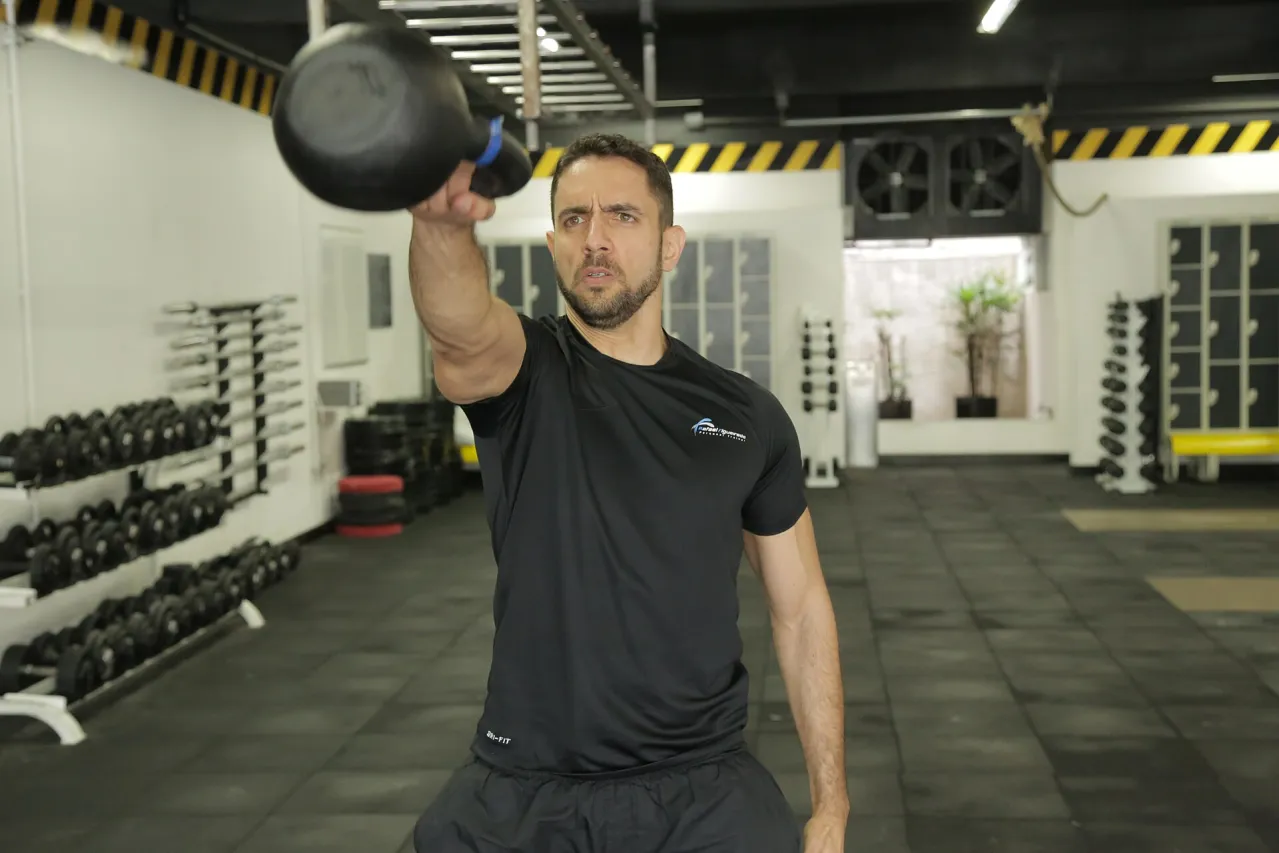
When you eat less, your body has less reason to keep muscle. Lifting weights, or any training that challenges your muscles progressively, sends the opposite signal. That is why strength work is the centre of a good weight-loss plan rather than an extra. It also makes everyday life easier, protects joints and bones, and changes how your body looks at a given weight.
A sensible beginner programme uses a handful of movement patterns: a squat or leg press, a hip hinge such as a Romanian deadlift or kettlebell deadlift, a push such as a press-up or dumbbell press, a pull such as a row or lat pulldown, and a carry or core exercise. Two or three sets of each, in a range of about 6 to 15 repetitions, stopping with one to three repetitions still in reserve, is plenty to start. The key is progression: a little more weight, an extra repetition or better control from week to week.
This works in almost any setting. A building gym with dumbbells and a cable machine is enough, and many coaches bring kettlebells and bands to home sessions. If you are deciding where to train, our guide to home versus gym personal training compares the options.
5. Steps in a city built for cars
The largest difference between people who lose weight easily and those who struggle is often not the gym session but everything else they do in the day. Walking, standing, climbing stairs and moving around the house add up to far more energy than one workout. In Dubai, Abu Dhabi and Sharjah this everyday movement is unusually low: many people drive from an underground car park to an office car park and back again, and summer heat makes walking outside unattractive for months.
So the step target needs a plan. Start by measuring your normal week, then add about 1,500 to 2,000 steps a day on top of it, and increase again once that feels normal. Seven to ten thousand steps a day is a good range for most people. Ways that work here:
- Walk after meals. Ten to fifteen minutes after lunch or dinner is easy to repeat and pleasant even in warm weather if you use an indoor route.
- Use indoor routes in summer. Malls, long building corridors, covered walkways and treadmills in residents’ gyms all count. Many people walk laps of a mall in the early evening from June to September.
- Walk outdoors when the weather allows. From October to April waterfronts, parks and beaches are at their best early in the morning and after sunset.
- Build it into the commute. Park at the far end of the car park, take the metro one stop further or take the stairs for a few floors.
- Walk your calls. Phone meetings are an easy source of a thousand extra steps.
The WHO physical activity guidelines recommend 150 to 300 minutes of moderate activity a week for adults, plus muscle-strengthening work on at least two days. A daily walk and two strength sessions meet that comfortably.
6. Food: enough protein, fewer liquid calories, a plan for eating out
Your coach may give you general nutrition guidance, but a detailed meal plan for a medical condition is the job of a licensed dietitian. For most healthy adults, a few principles do most of the work:
- Eat enough protein. Around 1.2 to 1.6 g per kilogram of body weight a day suits most people who are training and eating less; research on resistance training suggests that benefits for muscle level off at about 1.6 g/kg (Morton and colleagues, 2018). In practice that means a palm-sized or larger portion of chicken, fish, eggs, Greek yoghurt, labneh, lentils, chickpeas or tofu at each meal.
- Watch the drinks. Fresh juices, smoothies, sweetened iced coffees and karak tea are easy to underestimate. Swapping two of them a day for water, unsweetened tea or black coffee can make the deficit on its own.
- Have a delivery-app routine. Ordering in is part of life here. Pick two or three go-to meals from places near you that are built around protein and vegetables, so that a late evening does not become a guessing game.
- Plan the brunch, do not cancel it. A weekend brunch or a family dinner is not a failure. Eat normally before it, choose protein and salads first, go easy on the sweet drinks, and get back to routine the next day. One meal does not undo a week; a weekend of giving up can.
- Keep alcohol occasional. If you drink, alcohol adds calories and tends to loosen every other food decision that evening.
Tracking food in an app for two or three weeks is a good way to learn what portions really look like. It does not need to become a permanent habit.
7. Training in the heat
From June to September, outdoor sessions in the UAE need care. Train early in the morning or late in the evening, move most work indoors, and drink regularly through the day rather than only during the session. If you sweat heavily, weigh yourself before and after a hard session: each kilogram lost is about a litre of fluid to replace, ideally with some electrolytes. Dizziness, headache, confusion or a sudden stop in sweating are warning signs to stop immediately and cool down. Our guide to training in the Dubai heat covers this in more detail.
Heat also affects the scale. After a hot week, or after a salty meal, body weight can jump by a kilogram or more from water alone. This is another reason to look at weekly averages rather than single weigh-ins.
8. Ramadan, holidays and travel
Ramadan does not have to stop progress, but it does change the plan. Many people find that training after iftar, or late in the evening, works best, with shorter and lighter sessions than usual. Weight loss is rarely the right priority during the month; keeping some strength training and walking, eating enough protein at iftar and suhoor, and sleeping as well as possible is a good result. Our Ramadan training guide explains the options. In 2027 Ramadan is expected to begin around 8 February.
Summer travel is the other big interruption. Agree a short hotel or home routine with your coach before you leave: twenty to thirty minutes of bodyweight or dumbbell exercises three times a week and a daily walk is enough to come back without losing ground. Ask whether your package can be paused while you are away.
9. Sleep and stress
Short sleep makes weight loss harder in very concrete ways. It increases hunger, reduces energy for training and makes food decisions in the evening worse. In a well-known controlled study, people on the same diet who slept 5.5 hours instead of 8.5 lost noticeably less fat and more lean mass (Nedeltcheva and colleagues, 2010). If your schedule allows only one change this month, protecting seven hours of sleep may help more than another workout.
10. Training alongside weight-loss medication
Many people in the UAE now lose weight with prescription medication such as semaglutide or tirzepatide, under the care of a doctor. These medicines reduce appetite and can lead to large losses, but in clinical trials a substantial part of the weight lost was lean mass rather than fat; in the semaglutide STEP 1 trial body-composition substudy it was roughly two fifths (Wilding and colleagues, 2021). That makes strength training and adequate protein more important, not less.
If you use these medicines, tell your coach. Expect smaller meals and lower energy on some days, so sessions may need to be shorter. Prioritise strength work over long cardio, eat protein first at each meal and drink enough. Your doctor remains in charge of the medication; your coach’s job is to help you keep muscle and build habits that will last if and when the medication stops.
11. Measuring progress properly
Daily weight jumps around with water, salt, hormones and digestion. Looking at it once a day and reacting to every change is a fast route to frustration. A better system combines a few measures:
| Measure | How often | What to look for |
|---|---|---|
| Body weight | 3 to 7 mornings a week, same conditions | The weekly average, compared with the previous week |
| Waist | Every 2 weeks, at the navel, relaxed | A steady downward trend |
| Strength | Every session | More weight or repetitions on the main exercises |
| Steps | Daily, from your phone or watch | Weekly average at or above the target |
| Photos | Every 4 weeks, same light and clothes | Changes the scale does not show |
| Consistency | Weekly | Sessions completed out of sessions planned |
If the weekly average has not moved for three weeks while you have followed the plan, it is time to adjust: usually a little less food, or a few more steps, not a dramatic change.
12. A 12-week plan at a glance
- Weeks 1 to 2, set up. Health questions and goals with your coach, baseline measurements, learn the main exercises with light weights, measure your normal steps and add about 1,500 a day. Start a simple protein habit at breakfast and lunch.
- Weeks 3 to 6, build. Two or three strength sessions a week with steady progression, steps at the target range, swap high-calorie drinks, settle on your delivery and eating-out routine. First progress review at week 4.
- Weeks 7 to 10, push. Heavier main lifts, an optional short interval session, review the waist and weekly averages. Adjust food or steps only if the trend has stalled for three weeks.
- Weeks 11 to 12, consolidate. Repeat the measurements, compare with week 1, decide the next block. Many people continue losing for another block; others take a few weeks at maintenance before the next phase, which makes the result easier to keep.
13. Choosing a coach for weight loss
Look for a coach who asks about your health, schedule and food habits before talking about workouts, who puts strength training at the centre of the plan and who can explain how progress will be measured. Good signs include clear package terms, realistic targets and a willingness to work with your doctor or dietitian.
Be careful with anyone who promises a specific number of kilograms by a fixed date, sells supplements or “fat burners” as part of the package, recommends very low-calorie diets without medical supervision, or criticises your body. None of these predicts results, and some are risky.
You can compare coaches who list weight loss as a speciality in Dubai, Abu Dhabi and Sharjah, with their qualifications, areas and package prices on each profile. Our guide to personal trainer costs explains how to compare packages fairly.
Frequently asked questions
How much weight can I lose in a month with a personal trainer?
For most people a realistic pace is about 0.5 to 1% of body weight per week, which is roughly 2 to 4 kg in a month at 80 to 100 kg. The first two weeks often show more because of water loss. The result depends far more on food, daily steps and sleep than on the number of sessions.
How many sessions a week do I need for weight loss?
Two coached strength sessions a week, plus a daily step target, is enough for most beginners. A third session, coached or alone, helps if you have a deadline. More sessions only help if you can keep them up for months.
Is cardio or weights better for losing weight?
Both use energy, but strength training protects muscle while you eat less, so more of the weight you lose is fat. Daily walking is the most practical form of cardio for most people. Long, hard cardio sessions are optional.
Can I lose weight training at home?
Yes. A coach can run effective strength sessions with dumbbells, kettlebells, bands and your own body weight. What matters is progression and consistency, not the venue.
Should I keep training during Ramadan?
Most people can keep lighter strength sessions and walking, usually after iftar. Treat the month as maintenance rather than a time to push weight loss, and speak to your doctor if you have a medical condition.
Ready to start? Browse weight-loss coaches in Dubai, or see all personal trainers in Abu Dhabi and Sharjah.